


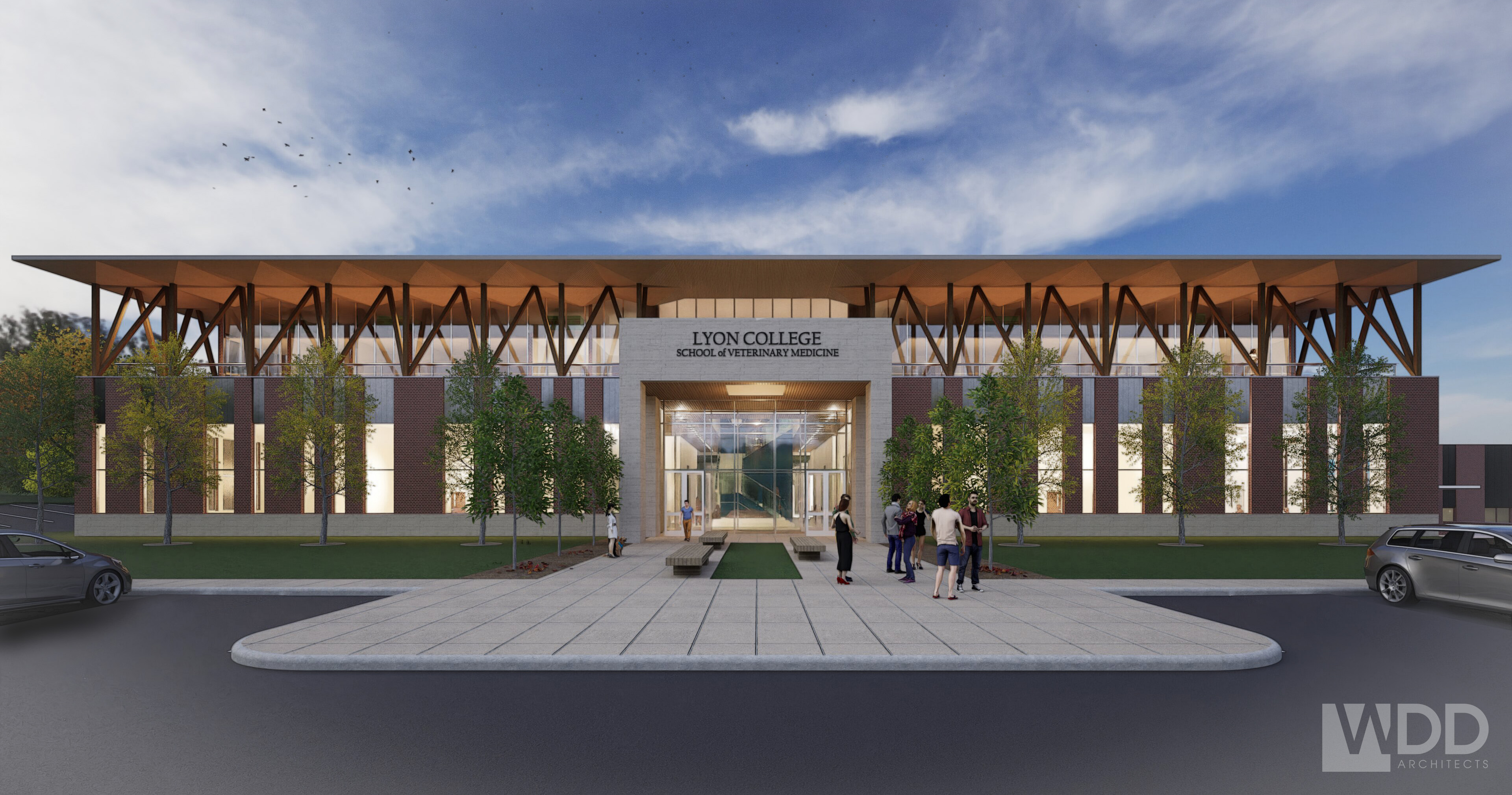
The Lyon College School of Veterinary Medicine (LCSVM) has received official notice of its comprehensive accreditation visit in summer 2026 by the American Veterinary Medical Association (AVMA) Council on Education (COE). This milestone marks a significant step forward in Lyon College’s efforts to establish the first private veterinary school in Arkansas.
In preparation for the visit, the LCSVM is developing a detailed self-study report that outlines its approach to implementing a Doctor of Veterinary Medicine (DVM) program and ensuring compliance with the 11 AVMA COE Standards of Accreditation. These standards cover critical areas such as institutional accreditation, organization, finances, facilities, clinical resources, curriculum, faculty, students and research.
“The comprehensive visit is an important next step in our pursuit of COE accreditation and reflects our commitment to meeting the highest standards in veterinary education,” said Dr. Melissa Taverner, president of Lyon College. “Our faculty and leadership team have worked diligently to design a program that prepares graduates to meet the evolving needs of animal health care in Arkansas and beyond.”
LCSVM will be co-located with Cabot Animal Support Services (CASS) on a campus off I-57 near Exit 21 in Cabot. Lyon College has partnered with the City of Cabot to support the development of its veterinary medicine program, providing access to facilities, community connections, and opportunities for student engagement in public and animal health initiatives. Cabot provides an excellent community with an outstanding school system that will contribute to faculty, staff and student recruitment.
As part of its progress, LCSVM announced the structure of its four-year Doctor of Veterinary Medicine (DVM) curriculum. Lyon College initially explored offering a three-year DVM program and, after critical review, determined that a four-year program would best support student learning and success by allowing for enriching summer internship programs and faculty-mentored research experiences.
The curriculum blends lectures, laboratories and small-group sessions, all enhanced by learning technologies, to best prepare students for diverse professional roles in veterinary medicine.
“The Lyon College DVM curriculum reflects our dedication to academic rigor, clinical excellence, innovative approaches and student-centered learning,” said Dr. Eleanor Green, founding dean of the Lyon College School of Veterinary Medicine. “At LCSVM, learning will be technology enhanced, active, applied and personal. Students will engage in collaborative projects, problem-solving exercises and case-based learning that connect science with compassion and creativity. From their first semester, they will integrate classroom knowledge with hands-on experiences, working with animals, communities and professionals who inspire them to think critically and lead with empathy. Our curriculum is designed to cultivate not only clinical competence but also resilience, curiosity and a commitment to lifelong learning. The emphasis is not just on what students learn, but how they learn, ensuring that each graduate leaves prepared to serve, to innovate and to make a lasting difference in veterinary medicine. We also want to ensure that graduates are well-prepared to leverage valuable technologies to enhance veterinary health care.”
Dr. Green said LCSVM’s hybrid clinical training model will ensure that students gain real-world experience in a variety of environments.
“Students will work alongside expert faculty clinicians within CASS and the LCSVM ambulatory services as well as with practicing veterinarians throughout a network of general and specialty practices across Arkansas and the nation. This distributed model gives them the flexibility to explore different career paths and practice settings while developing confidence, adaptability and professional judgment. By engaging with diverse patient populations and veterinary teams, students will gain a broader understanding of the field and be better prepared to meet the evolving needs of animals, clients and communities. Ultimately, this approach empowers graduates to tailor their training to their professional goals, whether in clinical practice, research, public health, industry or policy, and to enter the workforce ready to make a meaningful impact.”
Supported by an $11 million gift from the Arkansas Animal Rescue Foundation (AARF), the Katharine Reese Shelter Medicine and Animal Welfare Program will provide hands-on training through an on-site teaching hospital/shelter facilities within CASS and mobile veterinary units. With shelter medicine being recognized as a specific veterinary specialty under the American Board of Veterinary Specialties, the program will serve as a center of excellence, advancing veterinary education, community outreach and animal welfare across Arkansas.
Classes are expected to begin in 2027.
The Lyon College School of Veterinary Medicine joins the Lyon College School of Dental Medicine in Little Rock as part of the college’s expanding network of professional programs in central Arkansas -- each designed to broaden access to health sciences education and address critical workforce needs throughout the region.
For more information about the Lyon College School of Veterinary Medicine, visit lyoninstitute.com.