


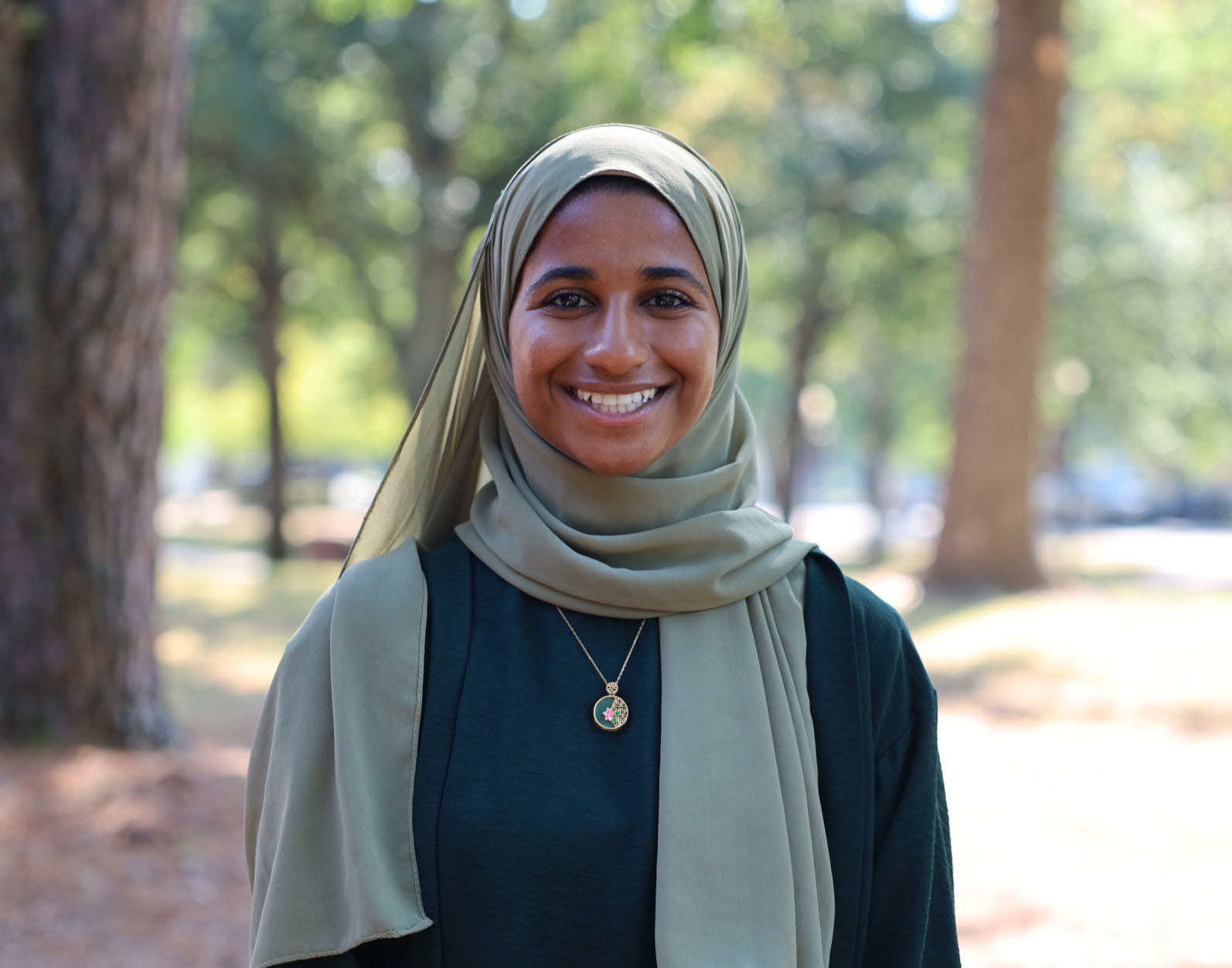
Aisha Mahmoud, a 2024 computer science and data science graduate from Lyon College, recently celebrated a milestone achievement as the first author of a peer-reviewed scientific article published in PLOS ONE. The study, "Examining Mammalian Facial Behavior using Facial Action Coding Systems (FACS) and Combinatorics", completed in collaboration with Dr. Britt Florkiewicz, assistant professor of Psychology at Lyon College, explores mammalian facial expressivity by applying Facial Action Coding Systems (FACS) to chimpanzees and cats, offering a new tool to study animal behavior.
The journey began when Aisha stumbled upon a post on the myLyon app about openings in Dr. Florkiewicz’s Animal Behavior and Cognition Lab. While the original project had no remaining research assistant slots, Dr. Florkiewicz introduced Aisha to another intriguing endeavor: developing a program to analyze facial combinatorics across species. This marked the start of a collaborative journey that would combine Aisha’s programming expertise with Dr. Florkiewicz’s psychological research.
“I never imagined I’d be contributing to a scientific article, let alone as a lead author,” Aisha shared. “I simply wanted to see how my data science background could assist in solving a problem. It’s been an incredible experience.”
At the heart of the research lies the challenge of applying FACS to identify potential facial configurations in mammals. Every facial expression is composed of specific muscle movements, or Action Units (AUs). However, simply generating permutations of AUs is not enough as physical constraints and species-specific rules dictate how these combinations manifest.
Aisha’s task was to program a tool that accounted for these rules. For example, AU25 (lips part) and AU27 (jaw stretch) must appear together, as one cannot stretch their jaw without parting their lips. Other AUs, like AU16 (lip lower), require AU25 but not vice versa.
“If we just plugged these AU numbers into a computer to come up with all the different AU combinations, the computer wouldn’t inherently know these logical ‘rules’,” said Aisha. “It would just spit out a bunch of different combinations that don’t actually make any physical sense. This is the basis of the program I wrote and the challenge we had to get around technically.”
By collaborating closely with Dr. Florkiewicz to map these rules, Aisha created a program capable of generating realistic facial expression combinations for both chimpanzees and cats. The program, designed for flexibility, can be adapted for use with any species provided researchers input the appropriate constraints.
“This tool opens the door for future researchers to explore previously uncharted aspects of animal behavior and communication,” said Aisha. “It’s exciting to think of the potential applications.”
Aisha credits much of her success to mentorship from Dr. Florkiewicz and the interdisciplinary environment at Lyon College. “Dr. Florkiewicz was an amazing mentor,” she said. “She gave me the freedom to approach the programming as I saw fit while staying in constant communication to refine ideas.”
In addition to guidance from Dr. Florkiewicz, Aisha consulted with her data science advisor, Dr. Marcus Birkenkrahe, for technical advice. This collaborative spirit, Aisha noted, was key to overcoming challenges such as optimizing the program’s efficiency and addressing complex logical problems.
The resulting research not only catalogs possible facial expressions in chimpanzees and cats but also raises intriguing questions: Why are some expressions observed while others remain unseen? Are they too subtle for humans to perceive, or do animals simply not use them?
Dr. Florkiewicz, who authored much of the manuscript’s field research sections, praised Aisha’s ability to translate complex programming methods into accessible language for publication. “Aisha’s contribution was essential,” she said. “This project demonstrates the power of interdisciplinary collaboration.”
Being a first author on a peer-reviewed article is a significant professional achievement, and for Aisha, it underscores the importance of stepping outside one’s academic comfort zone. “I never took a single psychology class,” she noted. “But by being open to opportunities, I found a way to contribute to an entirely different field.”
Aisha continued, “The moment when we found out that our article was accepted for publication was so exciting! It came after many months of hard work, editing and sending in for publication, and then the waiting game. Dr. Florkie told me over email with a lot of celebration emoticons and that accurately represented my feelings too.”
This experience has shaped Aisha’s career aspirations, solidifying her interest in interdisciplinary projects that merge programming with other scientific fields. She hopes to continue research that bridges gaps and creates tools to solve complex problems.
Her advice to fellow students is simple: “Explore opportunities, even those outside your major. Reach out to professors. The world is more interconnected than we realize, and you never know what doors might open.”
Aisha ended with, “It means a lot to me to be able to apply the skills I've learned in my undergraduate studies to real world applications and see the answers they unlock. I’m very grateful to the community of mentors who have believed in me through this journey and helped guide me through it. I’m honored that I could help in building a tool that leads to important contributions to the research of animal behavior and cognition!”